
How Are Physicians Using AI in Clinical Practice?

AI is showing up across nearly every sector right now, but how is that playing out in medicine? Which tools are physicians using, and how are they putting them to work in clinical practice?
To find out, we conducted a study to find out what’s happening during and between consultations. Whether it’s tracking down a treatment guideline or wrapping up notes at the end of the day, AI is finding a permanent home in everyday practice. From specialized medical search tools to ambient scribes, physicians are bringing AI tools into the mix.
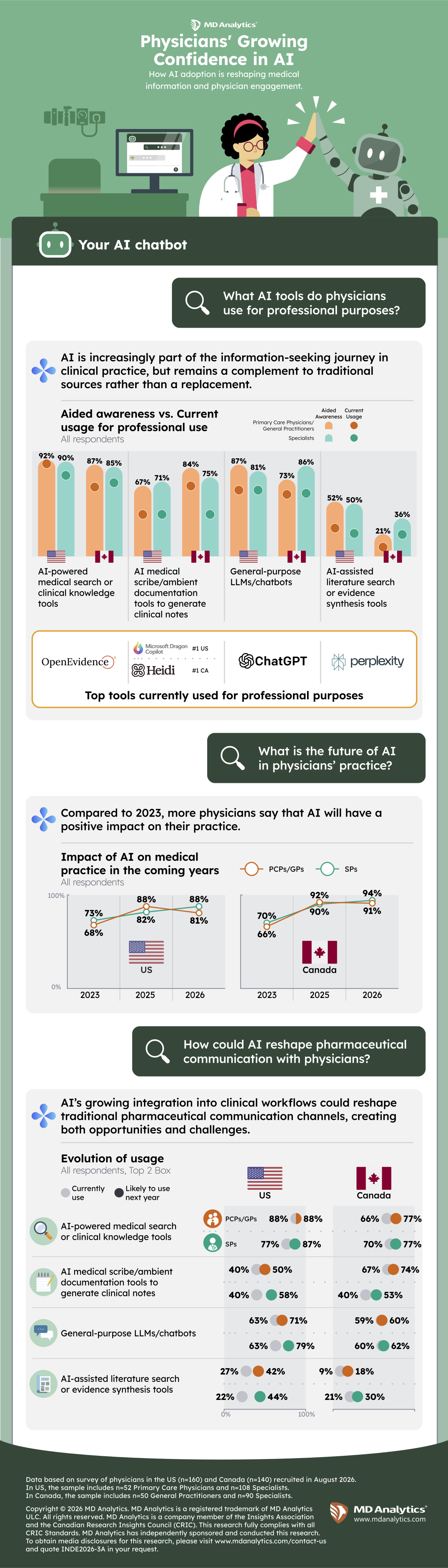
Behind that shift is a noticeable uptick in confidence. In our 2026 research with 300 U.S. and Canadian physicians, sentiment has noticeably brightened since 2023, particularly in Canada, with more doctors expecting to adopt AI scribes, medical search tools and EMR-integrated tools in the coming year.
Research and design by MD Analytics. Explore our approach to research reporting.
What does this mean for physician engagement?
AI-powered medical search tools were more widely used than general-purpose chatbots across all four physician groups surveyed. For pharmaceutical teams, this is a direct connection to physician engagement: AI is already part of how many physicians find clinical information and access medical evidence.
The country comparisons show that enthusiasm and adoption can tell different stories. Canadian physicians were more optimistic about AI’s future impact, with more than nine in ten GPs and specialists expecting a positive effect on their practice. Yet U.S. physicians reported higher use of medical search tools in both physician groups. Canada’s more positive outlook therefore doesn’t mean these tools are more established there.
Physicians’ future intentions suggest that AI could become more involved in reviewing published evidence, too. Among U.S. specialists, 44% were likely to use AI-assisted literature search or evidence synthesis tools next year, compared with 22% currently using them. For pharmaceutical teams communicating clinical evidence, this is a relevant area of potential growth: AI could increasingly sit alongside journals, guidelines and other sources physicians use to find and review medical information.
Our 2025 research found strong physician interest in partnering with pharma on AI, while outreach from pharmaceutical companies remained limited. These new findings show where AI is already being used in clinical practice, giving pharma teams more context for considering how they could support physicians.
The findings in detail
Current use of AI tools in clinical practice
| AI tool and physician group | U.S. | Canada |
|---|---|---|
| Medical search / clinical knowledge: PCPs / GPs | 88% | 66% |
| Medical search / clinical knowledge: specialists | 77% | 70% |
| AI medical scribes: PCPs / GPs | 40% | 67% |
| AI medical scribes: specialists | 40% | 40% |
| General-purpose LLMs / chatbots: PCPs / GPs | 63% | 59% |
| General-purpose LLMs / chatbots: specialists | 63% | 60% |
| Literature search / evidence synthesis: PCPs / GPs | 27% | 9% |
| Literature search / evidence synthesis: specialists | 22% | 21% |
Source: MD Analytics, August 2026. U.S.: 52 primary care physicians
and 108 specialists. Canada: 50 general practitioners and 90 specialists.
All respondents; Top 2 Box results.
Expected positive impact of AI on medical practice
| Country | Physician group | 2026 |
|---|---|---|
| U.S. | Primary care physicians | 81% |
| U.S. | Specialists | 88% |
| Canada | General practitioners | 91% |
| Canada | Specialists | 94% |
Source: MD Analytics, physician AI research. All respondents; country and physician-group bases are listed above.
About the research
MD Analytics independently sponsored and conducted this research with 300 physicians recruited in August 2026. The U.S. sample included 52 primary care physicians and 108 specialists, for a total of 160 respondents. The Canadian sample included 50 general practitioners and 90 specialists, for a total of 140 respondents.
The infographic covers professional AI tool awareness and current use, expected impact on medical practice and likelihood of using the tools over the next year. It also presents comparisons with August 2023 and August 2025. Study reference: INDE2026-3A.